
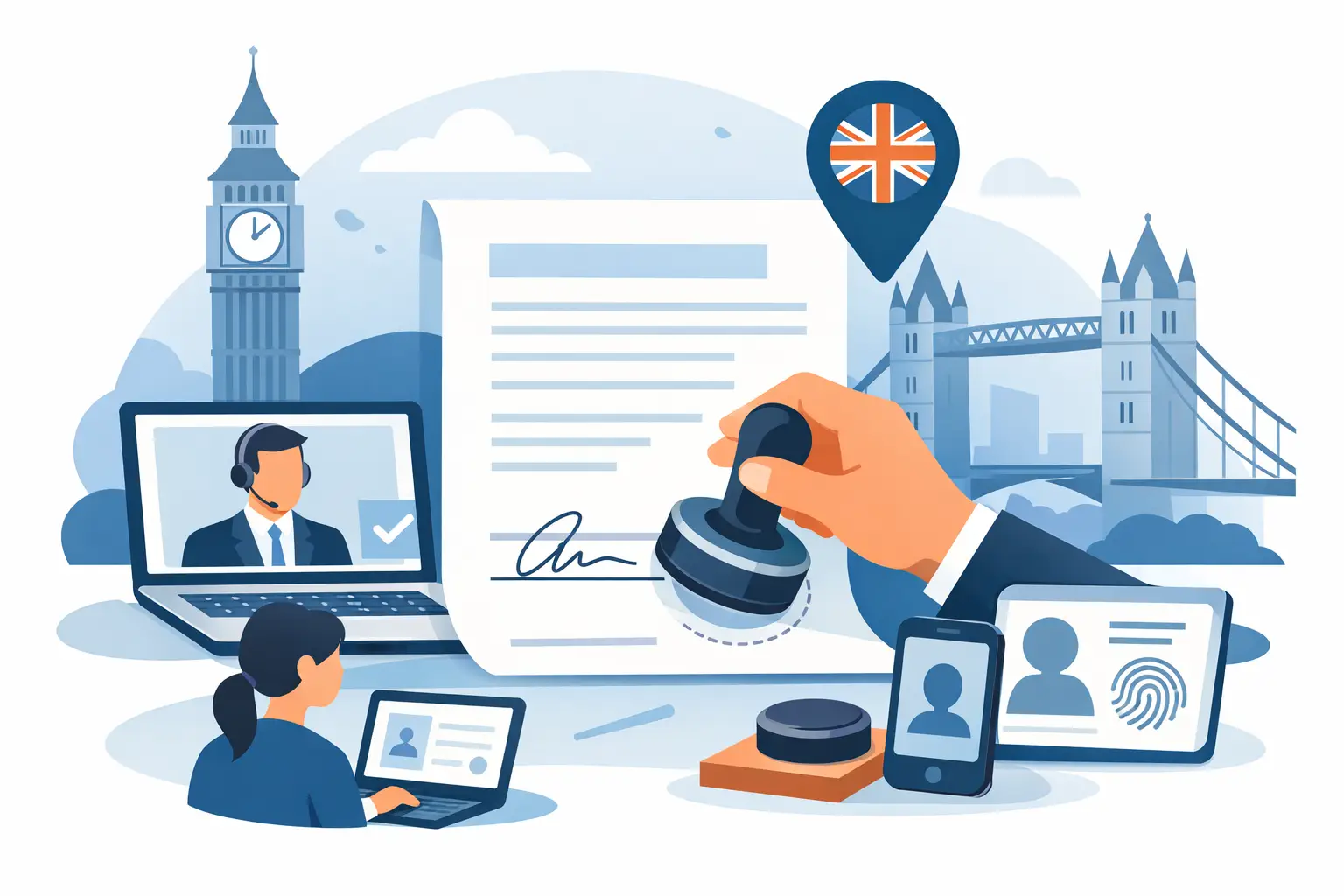
If you need a document notarised for use abroad by tomorrow, travelling across London for an appointment may be the last thing you want. That is why online notary public UK services have become such a practical option for individuals and businesses dealing with urgent international paperwork. Used properly, remote notarisation can save time, reduce delay and allow documents to be handled from almost anywhere in the world.
That said, online notarisation is not a shortcut around legal formalities. It still requires identity checks, careful review of the document, and confirmation that the receiving authority overseas will accept the notarised form you are providing. For some matters, it works extremely well. For others, a face-to-face appointment or an additional apostille may still be required.
What an online notary public in the UK actually does
A notary public is a qualified legal professional authorised to verify identity, witness signatures, certify documents and prepare notarial acts for use outside the UK. The purpose is not simply to stamp paper. It is to give foreign authorities, banks, lawyers and institutions confidence that the document has been properly executed and can be relied upon.
When the service is provided remotely, the legal function remains the same. The difference is in the method. Instead of attending in person, the client meets the notary by video, supplies identification electronically and signs or presents documents through an approved process. The notary then completes the notarisation in a form suitable for the transaction, subject to the rules that apply to the document and the country where it will be used.
This is especially useful where a client is overseas, unable to travel, working to a tight deadline, or handling several documents across different jurisdictions.
When online notary public UK services are most useful
Remote notarisation tends to suit matters where speed and location are the main obstacles. Private clients often use it for powers of attorney, certified copy passports, affidavits, consent to travel documents, declarations and supporting paperwork for overseas marriage, property or inheritance matters. Businesses may need remote notarisation for board resolutions, company documents, banking papers, shipping documents and cross-border commercial transactions.
The main advantage is convenience, but convenience is not the only point. For many clients, the real value is responsiveness. If a foreign lawyer, bank or authority has asked for notarised documents at short notice, being able to arrange a remote appointment quickly can keep a transaction moving.
There is, however, an important qualification. Acceptance depends on the receiving country and the receiving organisation. Some authorities are comfortable with electronically notarised documents. Others insist on wet-ink signatures, paper originals or further legalisation. That is why the right first question is not, “Can this be notarised online?” but “Will the person receiving it accept online notarisation?”
How the process usually works
The process is straightforward when handled properly. First, the notary reviews the document and asks what it will be used for, where it is going and whether any instructions have been provided by the overseas authority. This stage matters because notarial wording often needs to match the purpose of the document.
Next comes identity verification. You will usually be asked for proof of identity and proof of address, and sometimes further evidence showing why you are signing the document or your authority to do so. If it is a company matter, the notary may also need incorporation documents, board minutes, proof of office and confirmation that the signatory has authority to bind the business.
The appointment itself is then carried out by video. The notary confirms identity, ensures the signer understands the document, and checks that the signature is being made voluntarily. Depending on the type of notarisation, the document may be signed during the call or presented in signed form if the procedure allows.
After that, the notary completes the notarial act. In some cases the final notarised document is produced electronically. In others, physical documents still need to be issued, certified or forwarded for apostille and legalisation. That practical difference is often where clients need the clearest guidance.
The documents and checks you should expect
An online notary public UK provider should be thorough. That is a good sign, not an inconvenience. A proper notarial service will usually ask for your passport or driving licence, proof of address such as a bank statement or utility bill, and the document itself in advance. If names differ across documents, expect questions. If your document refers to an overseas property, company, court matter or family member, supporting papers may also be required.
For company documents, the checks are often more detailed because the notary must be satisfied not only about identity but also about capacity and authority. If a director is signing, the notary may need to see Companies House records, constitutional documents or a board resolution. If the signatory is acting under a power of attorney, that authority must be reviewed as well.
This level of care protects the client as much as the receiving authority. A rejected document can cost far more in delay and repeat fees than a careful review at the outset.
Online notarisation, apostille and legalisation
One of the most common points of confusion is the difference between notarisation and legalisation. Notarisation is the notary’s act of verifying, certifying or witnessing the document. An apostille is a government certificate that confirms the notary’s signature and seal so the document can be recognised abroad under the Hague Convention. Some countries also require embassy legalisation after the apostille.
So even if your document is notarised remotely, the process may not end there. If the receiving country asks for an apostille, the notarised document may still need to be submitted to the relevant authority in paper form. If embassy legalisation is required, additional steps and timescales will apply.
This is where practical advice matters. The fastest route is not always the simplest one, and the cheapest route is not always the one that avoids delay. If a document is urgent, it helps to confirm the full chain of requirements before the notarisation takes place.
Is online notarisation always accepted?
No, and any honest answer should say so clearly. Acceptance depends on the law of the destination country, the policy of the receiving organisation and the type of document involved. Some jurisdictions and institutions are fully comfortable with remote electronic notarisation. Others remain cautious, especially with property transfers, court documents, original powers of attorney or registry filings.
There can also be practical issues. A foreign land registry might insist on paper originals. A bank may ask for an ink signature. An overseas lawyer may accept a certified copy but not an electronically signed declaration. These differences are not unusual.
That does not mean online notarisation is unreliable. It means the service needs to be matched to the document. A responsive notary will usually ask for any instructions you have received from the bank, lawyer, court or authority abroad before advising on the correct route.
Choosing the right online notary public UK service
Speed matters, but not at the expense of accuracy. When choosing a provider, look for a notary who can explain the process plainly, identify whether your document is suitable for remote notarisation, and deal with apostille or legalisation if needed. Availability also matters. International document work rarely arrives at a convenient time, so urgent appointments, weekend availability and clear fees can make a real difference.
This is particularly true for clients outside the UK. If you are abroad and need a UK notary for a British document or a matter connected to England and Wales, you need a service that is used to handling remote verification and cross-border requirements without adding unnecessary complication.
M M Karim Notary Public London is one example of a practice built around that need, offering online, mobile and office appointments for clients who require fast and practical support.
What to do before your appointment
Before booking, gather the document, your identification and any email or letter from the overseas authority showing what is required. If you are signing for a company, collect the company documents as well. If there is a deadline, say so immediately. A notary can only help quickly if they know what the document is for and how urgent it is.
It also helps to ask one direct question at the outset: will the receiving authority accept remote notarisation, and do they require an apostille or embassy legalisation afterwards? If you do not know, send over their instructions. That small step often prevents the biggest problems.
Online notarisation works best when it is treated as a precise legal service rather than a convenience app. When the checks are done properly and the foreign requirements are clear, it can be one of the quickest ways to get critical documents ready for use overseas. If time is tight, the right notary will not only notarise the document but also help you avoid the delay of getting it wrong.