
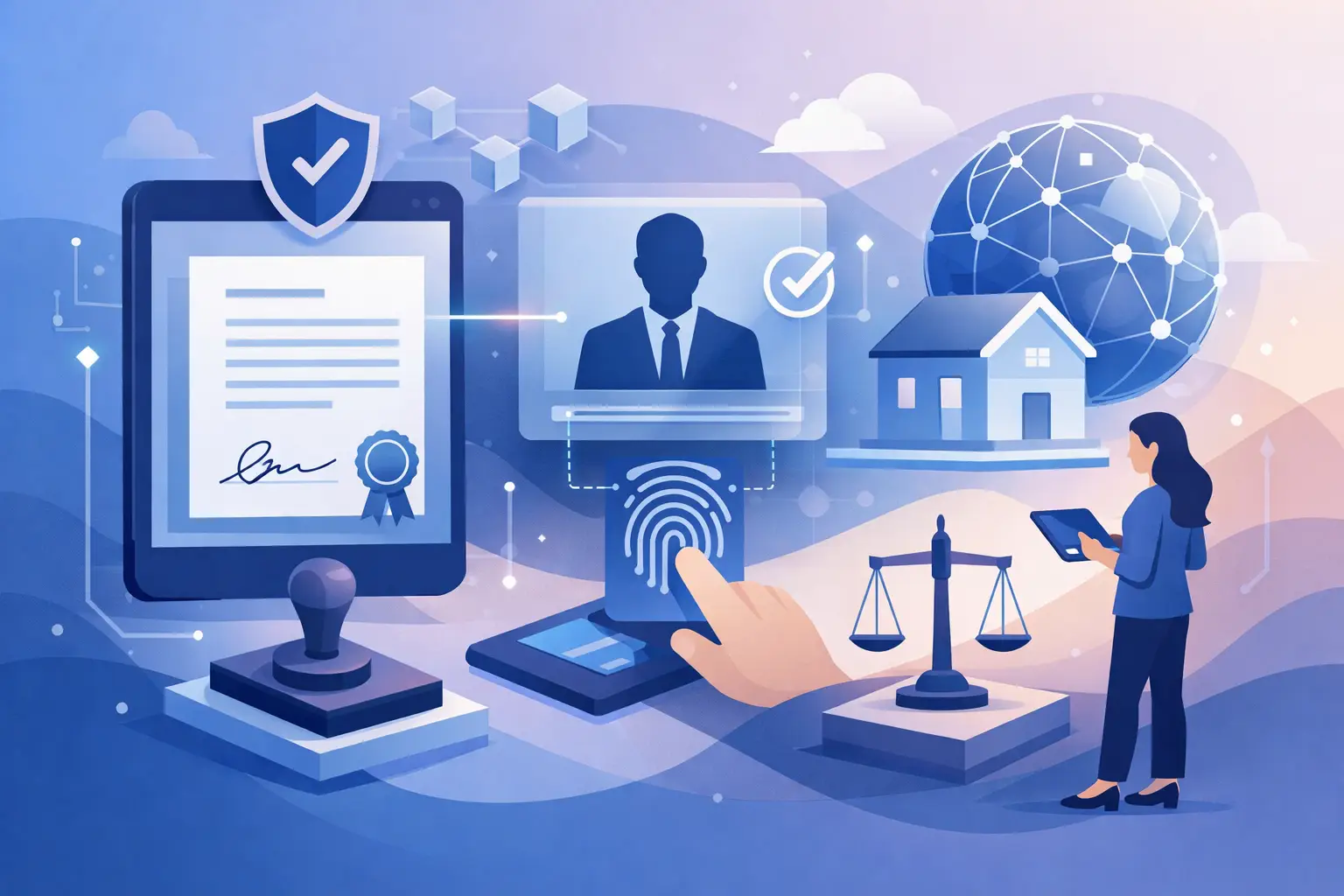
A client in Dubai needs a UK power of attorney signed today. A director in London is boarding a flight but still has to complete company documents for use in Europe. A family dealing with an overseas estate cannot afford a rejected affidavit because one step was handled incorrectly. This is where the future of digital notarisation stops being a talking point and becomes a practical question: how quickly, safely and reliably can legal documents be authenticated across borders?
Digital notarisation is already changing expectations. Clients now assume that identity checks can happen remotely, appointments can be arranged at short notice, and documents can move faster than the post ever allowed. That shift is real, but it does not mean every document can be handled in exactly the same way or that traditional notarial work is disappearing. The future will be shaped by convenience on one side and legal acceptance on the other.
What the future of digital notarisation really means
For many people, digital notarisation sounds simple: upload a document, show your passport on screen, sign electronically and receive a completed version within minutes. In some cases, that is close to reality. In others, it is not. The legal position depends on the document type, the destination country, the identity evidence available, and whether an apostille or further legalisation will follow.
The future of digital notarisation is therefore not just about technology. It is about whether foreign authorities, banks, land registries, courts and consulates will accept digitally notarised documents with the same confidence as paper originals. A remote signing process can be fast and secure, but if the receiving body insists on wet ink or a paper notarial certificate, speed at the first stage does not solve the wider problem.
That is why clients should expect a more mixed landscape rather than a complete switch to one model. Some transactions will move decisively online. Others will remain partly digital and partly physical for the foreseeable future.
Why demand is growing
The main driver is not fashion. It is pressure. People need documents completed urgently, often while they are abroad or dealing with multiple jurisdictions at once. Businesses want to reduce delays in cross-border transactions. Individuals want to avoid unnecessary travel for straightforward formalities.
Remote working has also changed what clients consider reasonable. If identity checks, banking, company filings and legal consultations can often be handled online, clients naturally ask why notarisation should always require a visit in person. In many cases, it does not. Where regulations permit, digital processes save time, reduce disruption and widen access.
This matters especially for international clients. Someone living outside the UK may still need a UK notary for a declaration, certified copy, power of attorney or company document. Digital options make that support possible without delay, provided the document is suitable for remote handling and the destination authority will accept the result.
The likely shape of digital notarisation over the next few years
Better identity verification
One of the strongest areas of development is identity checking. Expect more use of biometric verification, encrypted document uploads, liveness testing and cross-checking against official records. This should reduce fraud and give notaries stronger evidence when verifying signatories remotely.
That said, stronger technology does not remove professional judgement. A notary still has to assess whether the person signing understands the document, appears willing to sign, and is who they claim to be. Software can support that decision. It does not replace it.
More remote electronic notarisation
Remote electronic notarisation is likely to expand, particularly for clients who are overseas, housebound, travelling, or facing urgent deadlines. This is where a document is signed and notarised through a secure online process rather than across a desk.
The benefit is obvious: greater speed and accessibility. The limit is equally obvious: acceptance varies. Some countries and institutions are ready for it. Others are not. A practical notary will always start with the end use of the document, not simply the fastest available method.
Tighter digital audit trails
The future of digital notarisation will also involve stronger record-keeping. Electronic signatures, time stamps, encrypted certificates and digital logs can create a clearer audit trail than many traditional paper processes. That can be useful when documents are challenged or when authorities want to verify how and when execution took place.
For clients, this should mean greater confidence. For notaries, it means more responsibility to use trusted systems and keep records in a way that meets professional and legal standards.
Hybrid services becoming normal
In practice, many matters will be hybrid. A client may complete identity verification online, review the draft document by email, attend a video appointment, and then receive a paper notarial certificate for apostille and overseas use. That is not a weakness in the system. It is often the most effective way to meet legal requirements without adding unnecessary delay.
What will not change
Technology will improve delivery, but the core role of the notary remains the same. A notary is not simply a witness with a webcam. The work involves verification, judgement, formal certification and an understanding of international document requirements.
Clients still need advice on whether a document should be signed in a particular way, whether supporting evidence is required, whether a translation is needed, and whether the destination country requires apostille or consular legalisation. These are the points where mistakes become expensive.
The future of digital notarisation will favour firms that combine speed with legal accuracy. Quick service is useful only if the document is accepted at the other end.
The main challenges ahead
The biggest challenge is inconsistency. Different countries have different rules. Different receiving bodies within the same country may take different views. A digitally notarised document that is accepted by one authority may be rejected by another.
There is also the issue of risk. Fraud prevention, cyber security and data protection are not side issues when passports, corporate documents and sensitive personal records are being handled electronically. Clients should expect secure systems, clear procedures and careful identity checks, even if that makes the process slightly more detailed.
Another challenge is public misunderstanding. Some people assume that an electronic signature alone is enough. Sometimes it is. Often it is not. Notarisation, certification, apostille and legalisation are separate steps, and digital convenience does not merge them into one.
What clients should look for now
If you need a document notarised for use abroad, the sensible question is not whether digital is better than in-person. The real question is which method is suitable for your specific document and destination.
A good notarial service should ask what the document is for, where it will be used, who is requesting it, and whether legalisation is needed afterwards. If those questions are not being asked, the process may be too generic for an international legal document.
You should also look for flexibility. Some matters can be completed remotely. Others may need an office appointment, a mobile visit, or a combination of both. Speed matters, but so does choosing the right route at the start.
This is where experienced practices such as M M Karim Notary Public London can add real value. Clients often come with urgency, not certainty. They need someone who can explain what is possible, act quickly and avoid wasted steps.
A more accessible service, but not a simpler legal world
Digital notarisation will make notarial services more accessible. It will help private clients dealing with overseas property, travel consents, inheritance matters and immigration paperwork. It will also help companies managing board resolutions, powers of attorney, banking papers and cross-border transactions under time pressure.
But greater access does not mean the legal environment becomes simpler. If anything, it may make expert guidance more important, because clients will have more options and more assumptions about what can be done online. The right approach will continue to depend on the document, the country and the urgency.
The firms that serve clients well in this next phase will be the ones that combine technology with judgement. They will offer remote options where appropriate, in-person support where necessary, and honest advice when a faster method is not the safer one.
For anyone dealing with international documents, that is the most useful way to think about the future of digital notarisation: not as a replacement for proper notarial practice, but as a better way to deliver it when the law, the evidence and the receiving authority allow it.