
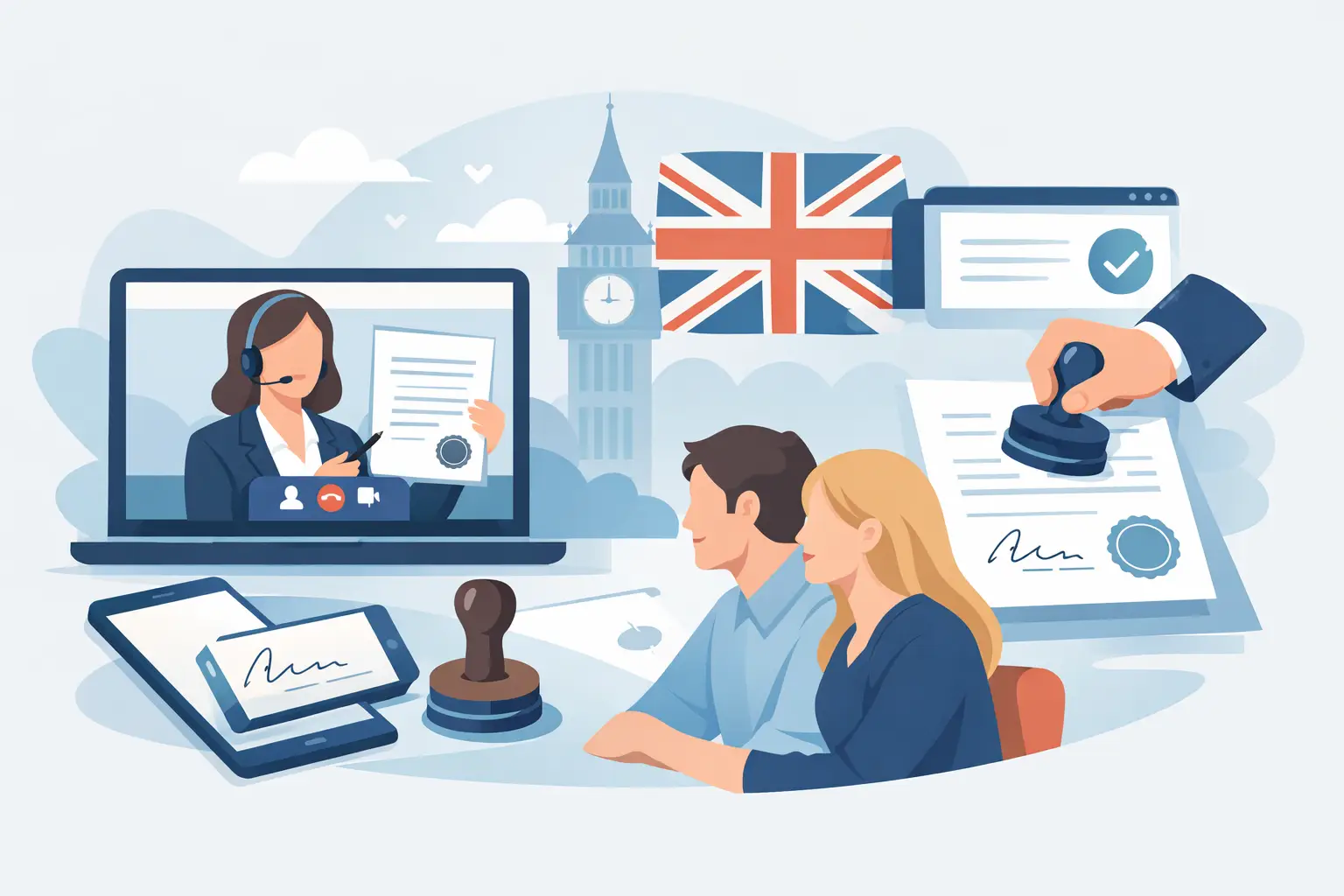
A document for a property sale in Spain, a power of attorney for family in Pakistan, company papers needed by a bank in the UAE – these matters rarely arrive with much notice. When time is short, online notarisation can be the difference between meeting a deadline and having your documents rejected or delayed.
For many clients, the main question is simple: can this be done remotely, properly, and in a way that will be accepted abroad? The answer is often yes, but not always in every case or for every country. That is where careful checking matters. Online notarisation is convenient, but convenience only helps if the final document meets the requirements of the receiving authority.
What online notarisation actually means
Online notarisation is the process of having certain documents notarised remotely using electronic communication and identity checks, rather than attending a notary’s office in person. In practical terms, the client and notary meet by video, the client proves identity, the document is reviewed, and the notarial act is completed in an approved format.
That sounds straightforward, but there are legal and practical layers behind it. A notary is not simply witnessing a signature on a screen. The notary must be satisfied as to identity, capacity, willingness to sign, and the nature of the document. If the document is for use overseas, the notary should also consider whether the receiving country or institution will accept a remotely notarised document and whether any further legalisation is needed.
This is why online notarisation is best treated as a professional process, not a shortcut. It can save time and remove travel, but it still requires proper scrutiny.
When online notarisation works well
Remote notarisation is often very useful for clients who are abroad, unable to travel, working to urgent deadlines, or signing routine cross-border documents. It can be especially helpful where the document is clearly prepared, the identity evidence is strong, and the receiving authority is known to accept electronic or remotely notarised documents.
Private clients commonly use it for powers of attorney, sworn statements, declarations, certified copies, and certain consent documents. Business clients may use it for corporate authorities, board paperwork, shareholder documents, and transactional papers where directors or signatories are in different locations.
The key point is that suitability depends on the document and the destination country. A remote process may be acceptable for one matter and unsuitable for another. For example, some overseas land registries, courts, or government departments still expect wet-ink originals or have very specific execution rules. Others are more flexible and will accept electronically notarised documents without difficulty.
When it may not be suitable
There are cases where an in-person appointment remains the safer option. If the receiving authority insists on a physical original, if the document has to be signed in a special manner, or if identity or capacity concerns need closer examination, remote notarisation may not be appropriate.
The same applies where the document will need an apostille or consular legalisation in a form that depends on physical paperwork. Some legalisation routes work perfectly well after remote notarisation, but some do not. It depends on the document format, the authority issuing the apostille, and the foreign consulate’s current practice.
That is why a responsible notary does not promise remote notarisation for everything. A quick yes is not helpful if the document is later refused overseas.
How the online notarisation process usually works
The process begins with a review of the document itself. The notary needs to know what the document is, who will sign it, which country it is for, and whether any supporting documents are required. If the document has been drafted by a foreign lawyer or institution, that wording may need to be checked before the appointment is confirmed.
Identity verification comes next. Clients are usually asked to provide proof of identity and proof of address in advance. Depending on the matter, further evidence may be needed, particularly where the signatory acts for a company or is relying on a change of name document, immigration status record, or other official paper.
At the remote appointment, the notary will confirm identity, review the document with the client, and make sure the client understands what is being signed. If an oath or declaration is involved, this must be handled correctly. The notary then completes the notarial act in the appropriate form.
After that, there may be a further stage if the document needs legalisation or apostille certification. This is where experience matters. A document can be correctly notarised but still require another step before it is ready for use abroad.
Online notarisation for overseas documents
Most clients looking for online notarisation are not doing so out of curiosity. They need a practical answer to an international problem. A child travel consent is needed before a flight. An affidavit must be signed for proceedings abroad. A company needs board papers notarised for an overseas bank account or subsidiary formation.
In these situations, the question is not only whether the document can be notarised online. It is whether the final version will satisfy the organisation receiving it overseas. Some foreign authorities ask for notarisation only. Others require an apostille. Others require both notarisation and embassy or consular legalisation.
This is one reason clients often prefer a specialist practice rather than treating notarisation as a simple witnessing service. International documents carry international rules, and those rules vary.
What clients should prepare before the appointment
A remote appointment moves much faster when the groundwork is done properly. The notary will usually need the unsigned document in advance, a valid passport or other accepted identification, proof of address, and any related papers that explain the transaction or authority involved.
If the signatory is acting for a company, corporate evidence may also be required. That might include certificate of incorporation details, Companies House information, board minutes, a resolution, or proof that the signatory has authority to bind the company. For business clients, this is often the stage that causes delay, not the video appointment itself.
It is also sensible to confirm the exact name format required on the document. Small inconsistencies between a passport, address proof, and the wording of the document can create unnecessary follow-up.
The real advantage: speed with control
The strongest case for online notarisation is not simply convenience. It is speed without abandoning legal control. A client in London, Manchester, Dubai, or Singapore may be able to deal with a UK notary remotely without having to travel, rearrange meetings, or lose days to couriering drafts back and forth.
For urgent matters, that flexibility matters. So does availability outside narrow office hours. Where a practice offers responsive appointments, clear fee information, and support with follow-on legalisation, the process becomes much easier for both private and commercial clients.
That said, speed should never mean rushing past the checks. A notary’s role is to protect the integrity of the document. If extra evidence is needed, or if the foreign authority’s rules are unclear, it is better to address that before the document is completed.
Choosing a notary for online notarisation
When selecting a provider, clients should look for more than the promise of a quick appointment. The important question is whether the notary understands overseas use requirements and can identify when remote notarisation is suitable and when it is not.
Clear communication matters. So does a willingness to review the document before the appointment and explain any likely next steps, including apostille or legalisation. A responsive service is especially valuable where clients are under time pressure or based in another time zone.
For that reason, many clients choose a specialist practice such as M M Karim Notary Public London, where online, mobile, and office appointments can be matched to the urgency and type of document involved.
Online notarisation is convenient, but acceptance comes first
The best remote notarial service does not begin with technology. It begins with the right legal question: what will the receiving authority accept? Once that is clear, online notarisation can be an efficient and reliable way to complete urgent international paperwork.
If you are dealing with documents for overseas use, the sensible approach is to check the document, the destination country, and the legalisation route before signing anything. That extra care at the start usually saves far more time than it costs.