
A document that is perfectly acceptable in the UK can be rejected overseas for one simple reason – it was not notarised correctly. That is often when people start looking for a mobile notary. Usually, the need is urgent, the document is time-sensitive, and the person signing has little room to travel, wait, or risk mistakes.
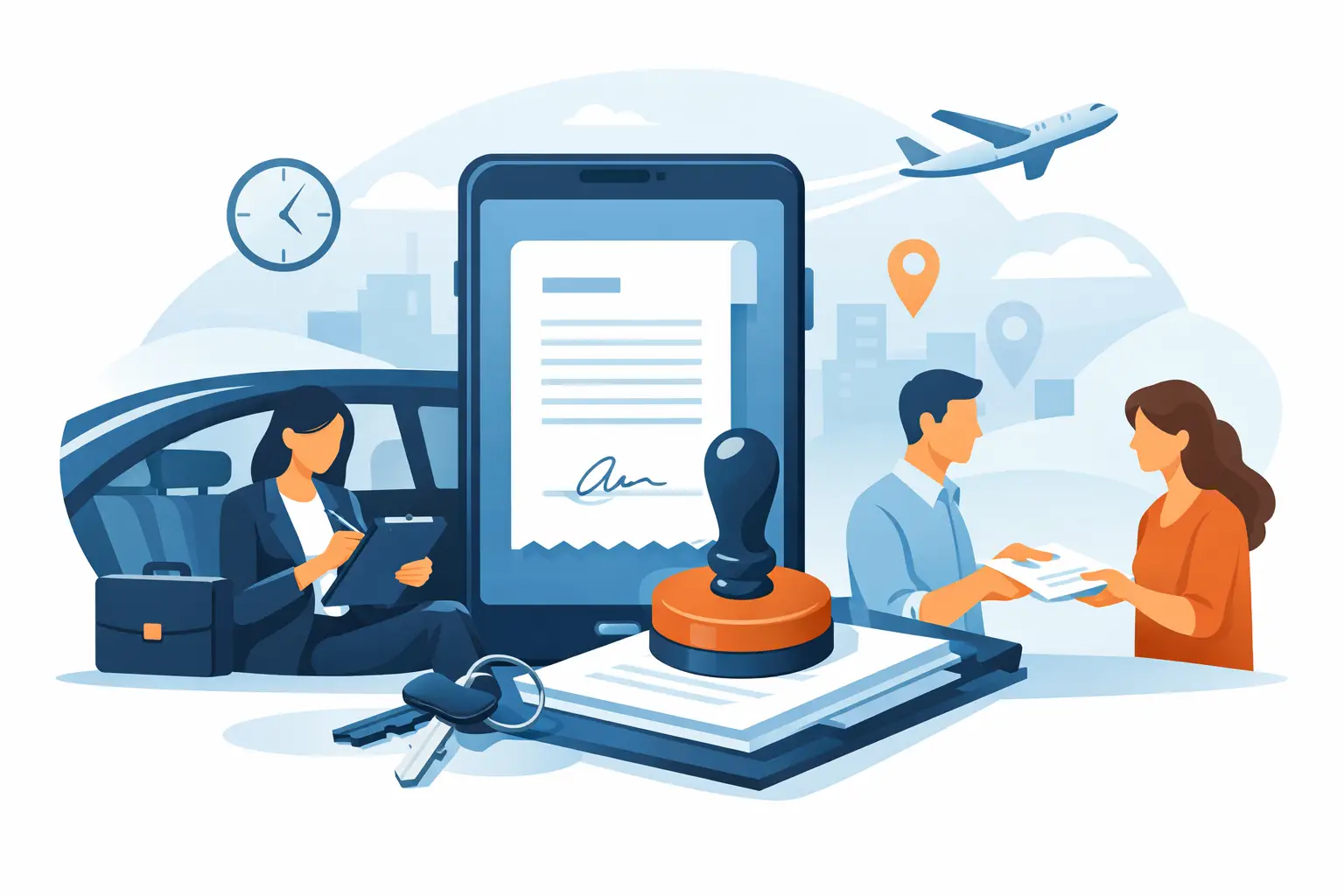
A mobile notary is a notary public who travels to you, rather than requiring you to attend an office. That can mean a home visit, an appointment at your workplace, a meeting at a hospital, a care home, or another convenient location. For clients dealing with overseas property sales, powers of attorney, travel consents, affidavits, company documents or identity paperwork, that flexibility can remove a significant obstacle.
What a mobile notary actually does
The role is not simply to witness a signature. A notary public verifies identity, checks legal capacity where needed, confirms that the person signing understands the document, and applies an official notarial certificate or seal so the document can be relied upon abroad. In many cases, the notary will also advise whether the document may need an apostille or further legalisation for the country where it will be used.
That distinction matters. Some documents can be signed quickly once the correct identification and supporting paperwork are available. Others require more care, especially where the document is in a foreign language, where authority to sign on behalf of a company must be proved, or where the receiving country has specific formalities. A mobile appointment offers convenience, but it does not remove the legal checks. A proper notarial service still needs to be accurate.
When a mobile notary is the right option
For many clients, the issue is not whether a document can be notarised, but how to get it done without losing time. A mobile notary is often the best option where travel is difficult, where several people need to sign in one place, or where business schedules make office attendance impractical.
This is particularly useful for individuals signing personal documents such as powers of attorney, declarations, certified copy passports, marriage paperwork, travel letters for children, inheritance documents or property documents for use overseas. It is equally valuable for companies needing a director, authorised signatory or multiple officers to sign board resolutions, banking papers, incorporation records, shipping documents or international transaction documents without disrupting the working day.
There are also more sensitive situations. If someone is elderly, recovering from illness, in hospital or unable to travel comfortably, a mobile appointment can be the most realistic way to complete the formalities. In those cases, the notary must still be satisfied that the person has capacity and is signing freely, so the setting may be convenient, but the standards remain the same.
Mobile notary appointments and urgent deadlines
International document work rarely arrives with generous notice. A bank abroad may request certified identification at short notice. A property lawyer may need a notarised power of attorney before completion. A shipping deadline may depend on original signed paperwork. When delay has commercial or personal consequences, speed matters.
A responsive mobile notary service helps because it reduces the time lost in travelling and waiting for a fixed appointment slot. It can also be easier to coordinate when several related steps are needed, such as notarisation followed by apostille or consular legalisation. That said, urgency does not mean every document can be turned around instantly. The timescale depends on the type of document, whether drafts are ready, whether identification is satisfactory, and whether additional legalisation is required after notarisation.
The safest approach is to have the document reviewed before the meeting if possible. That allows any issues to be identified in advance, rather than at the appointment itself.
What to prepare before the mobile notary arrives
Most delays happen because the document or identification is incomplete. Before the appointment, the notary will usually need to know what the document is for, which country it is going to, and whether the receiving authority has given any instructions. Those details can affect how the notarisation is worded and whether further steps are needed.
You should also expect to provide proof of identity and proof of address. A valid passport is commonly used for identification, and a recent bank statement or utility bill may be used for address verification. If the document relates to a company, the notary may also require Companies House records, constitutional documents, board minutes, signing authority or other evidence showing that the signatory is authorised.
Do not sign in advance unless you have been told to do so. Many documents must be signed in the notary’s presence. If the document is already signed, that is not always fatal, but it can create complications and may require a fresh version.
How a mobile notary service works in practice
The process is usually straightforward when handled properly. First, the document is reviewed and the notary confirms what is required. A fee quote and appointment time can then be arranged. The meeting takes place at the agreed location, identity and supporting documents are checked, the signature is witnessed or acknowledged, and the notarial certificate and seal are applied where appropriate.
If the document needs an apostille, that may be arranged afterwards. If it needs embassy or consular legalisation, that can also be handled as part of a wider service. For clients under time pressure, having those stages managed together is often more efficient than trying to coordinate them separately.
This is where experience matters. Different countries, authorities and institutions ask for different formalities. A document for Spain may not be treated the same way as one for the UAE, India or the United States. The practical value of an experienced notary is not just in witnessing a signature, but in reducing the risk of a rejected document later.
Costs, convenience and what affects the fee
Clients often assume a mobile notary is simply a standard notarial fee plus travel. Sometimes that is broadly correct, but the full cost depends on more than location. The complexity of the document, the number of signatories, the amount of verification required, and whether apostille or legalisation support is needed all affect the overall fee.
Travel outside normal hours may also increase the cost, as may evening, weekend or bank holiday appointments. Even so, for many people and businesses, the convenience is worth it. A director losing half a day to attend an office, or a family having to rearrange care or transport, can be more costly than the travel charge itself.
Clear pricing is important. A good service should explain what is included, what is extra, and whether courier, apostille or legalisation fees are separate.
Choosing the right mobile notary
Not every urgent document problem is solved by speed alone. Accuracy, responsiveness and clarity are just as important. You should look for a notary who is used to international document requirements, who can explain the process in plain English, and who is willing to review documents before the appointment where possible.
Availability also matters. Some clients need a same-day visit in London. Others need an early morning workplace meeting, a weekend appointment, or remote support alongside physical notarisation. A flexible practice can make a real difference when deadlines are tight.
For that reason, many clients choose a provider such as M M Karim Notary Public London, where mobile visits, urgent appointments and international document support are part of the service rather than an afterthought.
Is a mobile notary always necessary?
Not always. If you are able to attend an office easily, a standard appointment may be the simpler and cheaper option. In some cases, remote electronic notarisation may also be possible, depending on the document and the receiving jurisdiction. The right format depends on where the document is going, how quickly it is needed, and whether the original paper document must be notarised in person.
That is why it helps to ask the question at the start rather than booking the first available slot. Sometimes a mobile notary is the fastest solution. Sometimes an office appointment or remote process is more efficient. The key is to match the service to the document, not the other way round.
When a document is needed abroad, convenience should never come at the expense of legal correctness. The best mobile notary service gives you both – a practical appointment that fits around your life, and the confidence that your document has been prepared properly for use overseas.