
A missed signature, an uncertified copy or the wrong form of legalisation can hold up an overseas property purchase, visa application or business transaction. Knowing how to arrange mobile notary services properly means that your documents can be checked, signed and notarised at a location that works around your timetable – without compromising on the formalities required for use abroad.
A mobile appointment is particularly useful when you are unable to attend an office, managing an urgent deadline, coordinating several directors, caring for a relative, or preparing documents before international travel. The key is to contact a notary early enough to confirm the receiving country’s requirements, even if the appointment itself is needed at short notice.
What a mobile notary appointment involves
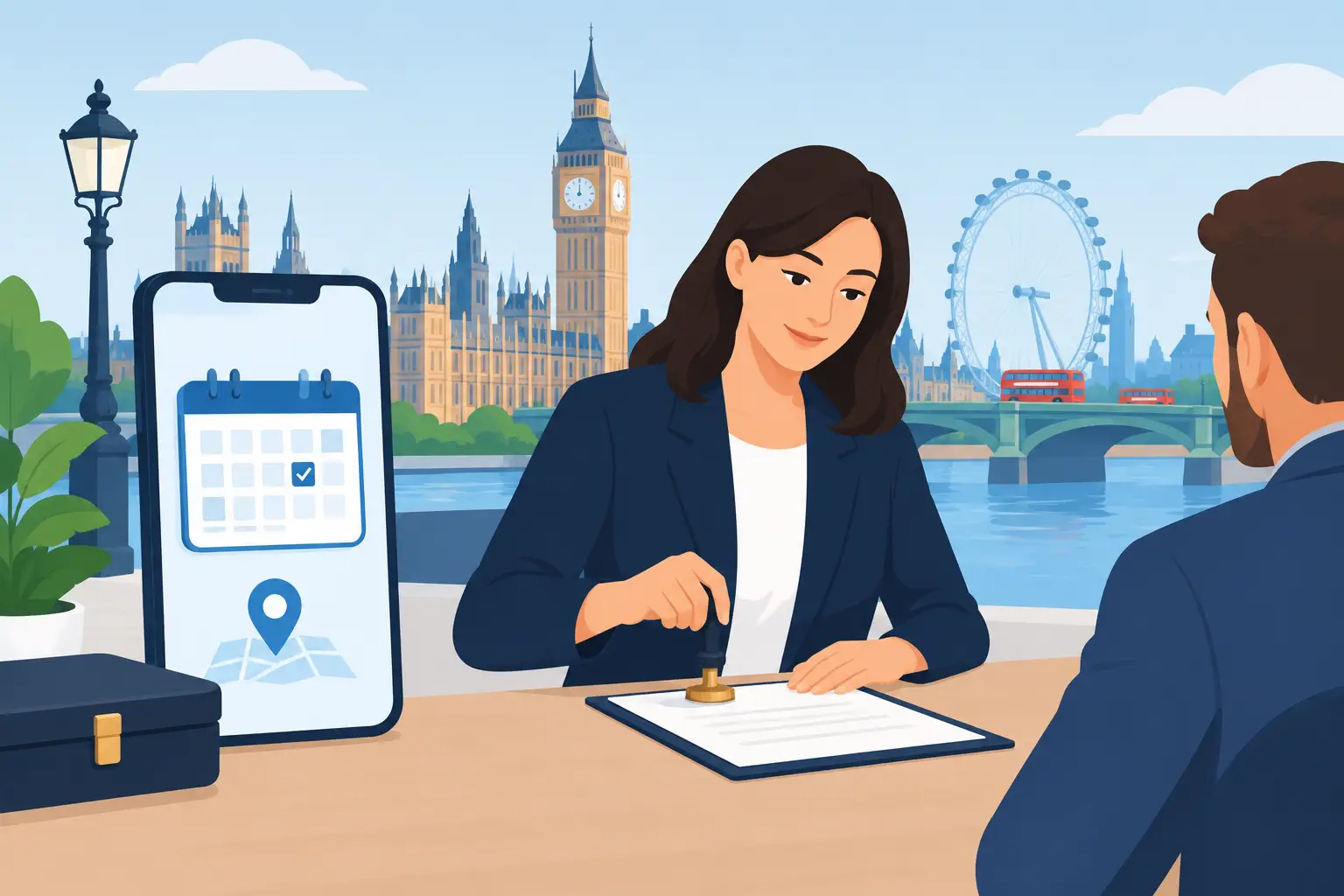
A mobile notary public travels to an agreed location to notarise documents. This may be your home, workplace, hospital, hotel, solicitor’s office or another suitable private setting in London or the wider UK. The notary verifies identity and capacity, witnesses signatures where necessary, certifies copies, and applies the notarial seal and signature required by the foreign authority.
Mobile service does not alter the legal standard. The same checks apply as they would at an office appointment. You will still need acceptable identification, original documents where relevant, and clear instructions about where the documents will be used.
The practical difference is convenience. For a company, one visit can allow multiple directors to sign resolutions, powers of attorney or banking documents together. For an individual, it can remove the difficulty of travelling while dealing with illness, childcare, work commitments or a tight departure date.
How to arrange a mobile notary appointment
Begin by sending clear scans or photographs of every document that needs notarisation. Include all pages, even blank-looking signature pages, attachments and schedules. State the country where the document will be presented and explain what it is for, such as a property transaction in Spain, a travel consent for a child, a UAE power of attorney or overseas company registration.
This first review matters. Some documents need only notarisation, while others require an apostille from the Foreign, Commonwealth & Development Office or further consular legalisation. Certain authorities ask for a particular form of wording, a certified copy rather than an original, or a signature witnessed in a specific way. Arranging travel before these points are checked can create avoidable delay and additional cost.
Once the document review is complete, agree a date, time and address. Give the notary enough information to assess whether the location is appropriate. A quiet meeting room is usually better than a busy café, particularly where confidential documents, identity checks or multiple signatories are involved. If several people must sign, confirm that all of them will be present with their own identification.
You should also request a clear fee estimate before confirming the booking. Mobile appointments can include a travel charge in addition to the notarial fee, especially for evening, weekend, bank holiday or longer-distance visits. The total will depend on the number of documents and signatories, the complexity of the work, urgency, travel time and whether apostille or embassy legalisation is required afterwards.
M M Karim Notary Public London can assess documents in advance and arrange flexible mobile, office or remote appointments according to the document type and destination requirements.
Do not sign too early
One of the most common mistakes is signing a document before the appointment. Many powers of attorney, affidavits, declarations and corporate documents must be signed in the notary’s presence. If you sign in advance, the document may need to be reprinted and signed again.
If a document has already been signed, do not assume it cannot be used. Send it for review before booking. In some cases, a notary may be able to certify an existing signature or prepare a suitable notarial certificate, but this depends on the document and the requirements of the country receiving it.
Documents to prepare before the visit
The notary will normally need to establish both your identity and your residential address. A valid passport is commonly used for photographic identification. A current UK photocard driving licence may also be accepted, depending on the circumstances. Proof of address is often provided by a recent bank statement, utility bill, council tax bill or official government correspondence.
Bring originals, not just images on your phone, unless you have been told otherwise. If a document is being signed for a company, the notary may also need company incorporation details, evidence of the signatory’s authority, board minutes or a directors’ resolution. For a power of attorney, provide any instructions supplied by the overseas lawyer, bank, property agent or government body.
Where a document is not in English, translation requirements need checking in advance. Some foreign authorities accept an English notarial certificate; others require a certified translation or documents prepared in their local language. This is not a point to leave until the appointment day.
For particularly urgent matters, have the following ready before requesting a mobile visit:
- Full scans of every document, including annexes and signature pages.
- The receiving authority’s instructions, reference number or template wording.
- Valid photo ID and separate proof of your current address.
- The full appointment address, available parking information and contact number.
- Details of every person signing and their role, especially for companies.
Choose the right service for the deadline
A mobile notary appointment is valuable, but it is not always the fastest or most economical option. If you can attend an office easily, an office appointment may avoid travel charges. If you are abroad or outside London, remote electronic notarisation may be available for documents that can legally be handled online and are accepted by the receiving party.
However, remote notarisation is not a universal substitute. Some documents still require wet-ink signatures, physical originals or a traditional notarial seal. Likewise, an apostille or consular legalisation is often a separate stage after notarisation and can affect your overall timescale. Ask for the full route from document review to final delivery, rather than focusing only on the earliest available appointment.
For urgent overseas use, timing should be measured from the day the completed document is needed, not the day it is signed. A document might be notarised quickly but still require apostille processing, embassy submission, translation or secure courier delivery. Giving the notary the final deadline and destination at the outset allows the work to be planned realistically.
Make the appointment run smoothly
On the day, ensure every signatory has their documents and knows which pages they are signing. The notary will need time to read the document, confirm understanding and willingness, check identification and satisfy themselves that the transaction is proper. This is especially relevant for elderly or vulnerable clients, powers of attorney, affidavits and documents involving significant financial commitments.
Avoid arranging the visit at the exact moment a document must be sent. Allow time for questions, corrections, printing if a signature page is wrong, and any final notarial wording. If documents must be apostilled, clarify whether the originals will be collected by the notary, returned to you first, or sent onward for legalisation.
For corporate bookings, nominate one person to coordinate the documents, director availability and company evidence. A single point of contact prevents the usual problems: an absent signatory, an outdated resolution or a missing passport can otherwise delay every document in the set.
Questions worth asking before you confirm
Before the appointment is booked, ask whether the receiving authority has confirmed its requirements, whether signatures must be witnessed, and whether the final document needs an apostille or embassy legalisation. Confirm the estimated fees, travel costs, appointment duration and likely completion time for any post-notarisation steps.
It is also sensible to ask how your original documents will be handled. For passports, certificates and property papers, establish whether they remain with you after the appointment or are needed temporarily for legalisation. Clear arrangements protect both your time and your documents.
A well-arranged mobile notary visit should feel straightforward: the requirements are checked before anyone travels, the right people and originals are ready, and the next legalisation step is already clear. When an overseas deadline is close, that preparation is often what makes the difference between a completed document and a costly delay.