
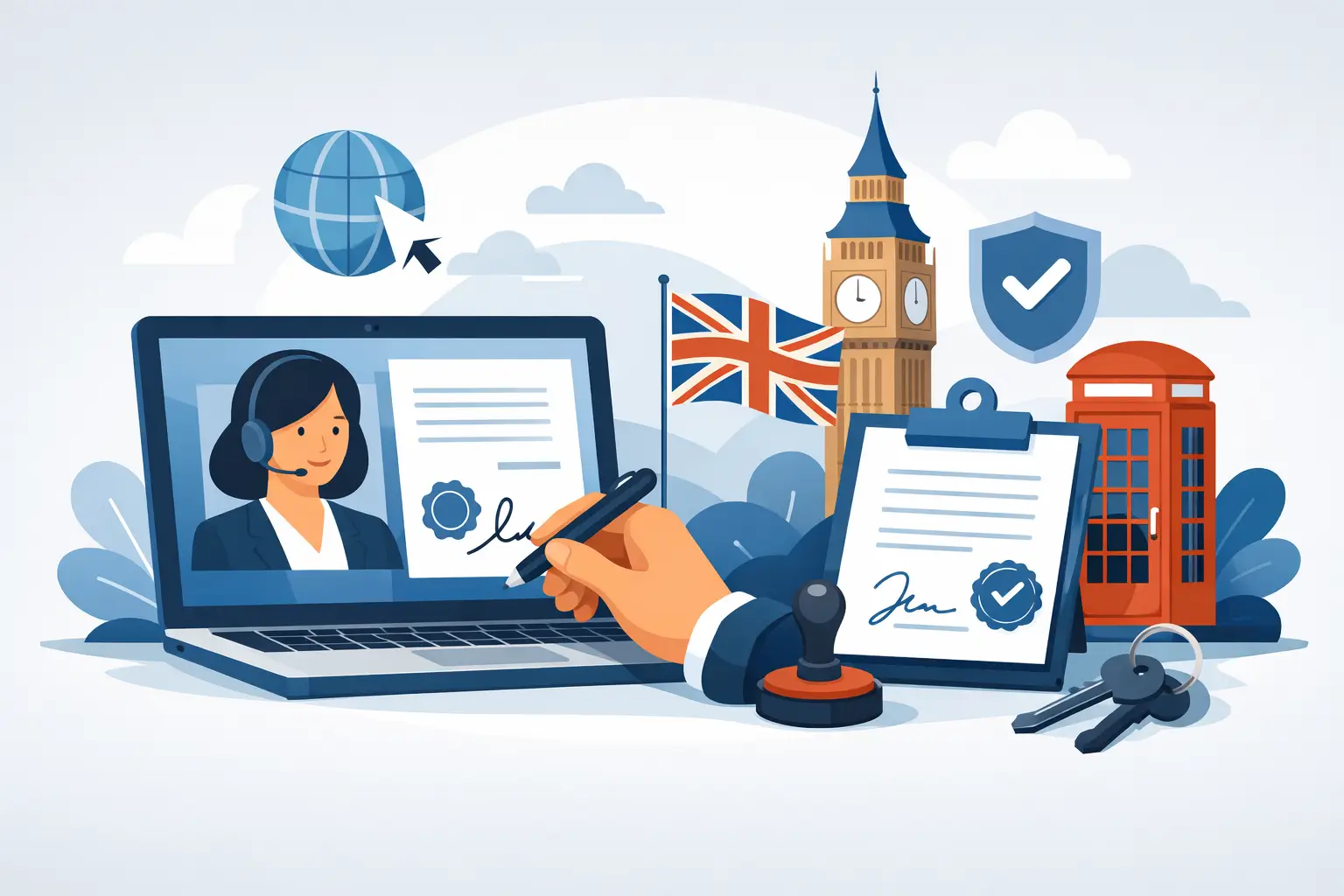
If you need a document notarised for use abroad, time is usually the problem. You may be dealing with a property completion in another country, a power of attorney for a relative, company papers for an overseas transaction, or travel documents that cannot wait. That is why interest in online notary UK services has grown so quickly. People want a lawful, practical way to complete formalities without losing days to travel, post, or limited appointment times.
The key point is simple. Online notarisation can be available in the UK, but it is not a one-size-fits-all service. Whether it is suitable depends on the document, the country where it will be used, the identity checks required, and whether the receiving authority will accept electronic notarisation.
What an online notary UK service actually means
An online notary UK service usually refers to remote notarisation carried out by a notary public using secure electronic processes. Instead of attending in person, the client joins a video appointment, proves identity, signs in the required way, and receives a notarised electronic document or a document prepared for the next stage of legalisation.
This is different from simply emailing a PDF to someone and asking for a stamp. A notary is a public officer with strict duties. The notary must verify identity, assess willingness and understanding, and keep proper records. If the matter calls for witnessing a signature, the notary must be satisfied that the signing process meets the legal and practical requirements for that document.
For many clients, the real advantage is convenience. If you are overseas, based outside London, working to a tight deadline, or trying to coordinate documents across time zones, remote notarisation can save a significant amount of time.
When online notarisation works well
Remote notarisation is often well suited to documents that need to move quickly across borders. Powers of attorney, affidavits, declarations, certified copy documents, certain company papers, and supporting documents for international legal or commercial matters may all be handled this way, depending on the circumstances.
For private clients, the most common situations include overseas property sales or purchases, immigration paperwork, parental travel consents, academic documents, identity documents, marriage-related papers, and inheritance matters. For business clients, it may involve board resolutions, company incorporation records, banking documents, shipping paperwork, and cross-border authority documents.
That said, suitability always depends on the receiving country and institution. Some foreign authorities are comfortable with electronically notarised documents. Others still insist on wet-ink signatures and paper originals. A good notary will tell you this at the outset rather than letting you pay for a process that may later be rejected.
When an online notary UK option may not be enough
This is where experience matters. Not every document should be dealt with remotely, even if it seems technically possible.
Some documents still require physical execution, original supporting papers, or a particular form of witnessing. Certain land, probate, court, or registry-related documents may need in-person attendance. Some embassies, consulates, banks, or overseas lawyers will only accept paper documents bearing original signatures and seals. If apostille or consular legalisation is needed after notarisation, the format of the notarised document can also affect what happens next.
In practical terms, the question is not just whether a notary can act online. The question is whether the completed document will be accepted without delay by the authority overseas. That is the standard that matters.
How the process usually works
A reliable online notary UK process starts before the appointment. The notary or their team should ask what the document is, where it is going, who has requested it, and when it is needed. They should also ask for a draft of the document and evidence of identity and address.
Once the document has been reviewed, the notary can confirm whether remote notarisation is appropriate. If it is, an appointment is arranged. During the video meeting, the notary will verify your identity, check that you understand what you are signing, and ensure that the signing process is carried out correctly.
After that, the notary prepares the notarial certificate and applies the required notarial formalities. In some cases, the final product is an electronic notarised document. In others, the matter may move on to apostille or legalisation, or a paper version may still need to be produced for the receiving authority.
The process sounds straightforward because, when handled properly, it is. The work behind the scenes is in checking requirements before anything is signed.
Identity checks are stricter than many clients expect
Clients are sometimes surprised by how much identification a notary asks for. That is normal. A notary is not simply witnessing a signature in the casual sense. The role includes anti-fraud checks, record keeping, and legal responsibility for the act being performed.
You will usually be asked for a current passport or other approved photo ID, plus proof of address such as a recent bank statement or utility bill. If the matter involves a company, additional corporate documents may be needed, including proof of authority to sign.
If the document relates to a wider transaction, the notary may also ask supporting questions. This is not unnecessary formality. It helps ensure the document is lawful, accurate, and fit for the purpose for which it will be used.
Online notarisation and apostille are not the same thing
Many clients use these terms interchangeably, but they are different stages. Notarisation is the act performed by the notary. An apostille is a certificate issued afterwards to confirm the authenticity of the notary’s signature and seal for use in countries that accept the Hague Apostille Convention.
Some countries require only notarisation. Others require notarisation followed by apostille. Some require both apostille and further embassy or consular legalisation. If the document is urgent, this distinction matters because each extra stage affects timing and cost.
This is one reason clients often prefer a practice that can deal with the full chain rather than only the first step. If the document is for overseas use, the notarisation must be approached with the end destination in mind.
What to look for in an online notary UK provider
The first thing to look for is clarity. You should be told promptly whether your document can be notarised remotely, what the receiving country requires, what identification is needed, and what the likely timescale will be.
The second is responsiveness. Most people seeking notarisation are not making a casual enquiry. They are facing a deadline, an overseas authority, or a transaction that will stall without the right paperwork. Fast replies, urgent appointments, and practical guidance make a real difference.
The third is flexibility. Some matters can be completed fully online. Others may start remotely but still require paper originals, legalisation, or a mobile appointment. A provider who offers office appointments, mobile visits, and remote notarisation is usually better placed to handle the complications that arise in real cases.
The fourth is transparency on fees. Low fees are helpful, but only if the service is suitable for your document. The right approach is to confirm the requirement first and the cost second, so there are no surprises later.
Common mistakes that cause delay
The most frequent problem is sending the wrong version of the document. Drafts, incomplete pages, missing exhibits, or unsigned annexures can all stop the process.
Another issue is assuming that online acceptance in one country means online acceptance everywhere. International document rules are not uniform. A document accepted in one jurisdiction may be rejected in another for a purely formal reason.
Clients also run into difficulty when names, addresses, passport details, or company information do not match supporting documents. Even a small inconsistency can create questions later, particularly where apostille or embassy legalisation is involved.
The safest route is to have the document checked before the appointment and to raise any uncertainty early. That is often what saves the most time.
Is online notarisation right for you?
If your priority is speed, convenience, and the ability to deal with an international document from wherever you are, an online notary UK service may be the right answer. It can be especially useful for clients abroad, busy professionals, and anyone trying to meet a short deadline without unnecessary travel.
But the right answer depends on the document’s destination, not just your preference. A proper notarial service should tell you when remote notarisation is the best option, when a paper original is safer, and when a different route is required. That kind of advice protects both your document and your deadline.
At M M Karim Notary Public London, the focus is on getting documents prepared correctly, quickly, and in the format the overseas authority is likely to accept. If your matter is urgent, the best next step is not to guess. It is to have the document reviewed properly so you can move forward with confidence.